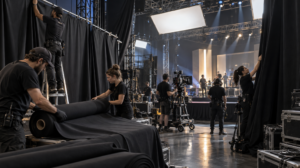
Behind nearly every polished film set, concert stage, photography studio, trade show, corporate event, and theatrical production is an assortment of materials the audience never notices. Those materials rarely receive top billing, yet they can have an enormous effect on what viewers ultimately see.
Duvetyne is one of them.
Known for its dark matte surface, opacity, and usefulness in controlling unwanted light, duvetyne has been used for decades in motion pictures, theaters, studios, and live productions. Today, its role reaches well beyond traditional stagecraft. As film crews, event companies, content creators, photographers, touring productions, and corporate production teams compete to create increasingly sophisticated visual environments, practical materials that can quickly solve lighting and staging problems have gained new business importance.
That makes duvetyne an interesting example of how a seemingly simple production supply can become part of a much larger commercial ecosystem. 🎬
A Production Material With a Long Professional History
Duvetyne is not a new invention created for the digital content era. Its history stretches back generations.
According to Wikipedia’s overview of duvetyne, the fabric traditionally features a twill weave with a velvet-like nap on one side. Its matte appearance and opacity have made it particularly useful for blocking light. The material has historically been associated with motion pictures, theatrical curtains, scenery, lighting control, and other production applications.
Those characteristics explain why it has remained useful despite enormous technological changes in entertainment.
Cameras have become more advanced. Lighting systems have moved from hot tungsten fixtures toward sophisticated LED systems. Production crews now use virtual sets, digital effects, drones, robotic cameras, and enormous video walls. None of those advancements has eliminated one of the most basic challenges on a set or stage, however.
Light still has to be controlled.
Reflections still have to be eliminated.
Backgrounds still need to disappear.
Equipment sometimes needs to be concealed.
Temporary production spaces still need to be transformed quickly.
A simple matte black fabric can accomplish several of those tasks without requiring expensive permanent construction.
Film Production Turns Practical Materials Into Business Essentials
Film and television production involves far more than cameras and actors. An entire commercial supply chain exists behind the finished content audiences eventually see.
Production companies purchase and rent lighting systems, rigging equipment, cameras, lenses, staging materials, expendables, fabrics, electrical equipment, sound systems, generators, temporary structures, and countless other specialized items.
That spending becomes significant when productions multiply.
The scale of the entertainment economy continues to create opportunities throughout the production supply chain. Recent reporting from Reuters on investment in U.S. film and television production highlighted just how much capital can be tied to production activity, with discussions surrounding a $1.5 billion commitment to domestic movie and television production as part of a major entertainment-industry transaction.
Money invested in production does not remain inside a studio. It moves outward through a network of vendors, contractors, rental houses, manufacturers, stages, transportation providers, set builders, lighting specialists, fabric suppliers, and production crews.
That creates an important business principle. Growth in content production can create demand far beyond the companies whose logos appear before a movie or television program.
The supporting suppliers matter too.
Light Control Has Commercial Value
The business case for duvetyne becomes easier to understand when its function is considered.
Professional imagery depends heavily on controlling light.
A lighting technician may need to stop illumination from reaching part of a set. A photographer may need to prevent reflections from contaminating a product image. A production designer may need to hide equipment that should not appear on camera. A stage crew may need to mask backstage areas from an audience.
Black fabric offers a flexible solution.
Rather than constructing a permanent wall or complicated enclosure, crews can hang, drape, clamp, or position material where it is needed. After the scene or event is finished, it can be removed and used somewhere else.
For businesses, that flexibility translates into efficiency.
Production equipment is valuable partly because it can solve problems repeatedly. A versatile material that works in studios, theaters, event halls, sound stages, convention centers, photography spaces, schools, churches, and temporary installations has considerably more commercial usefulness than a highly specialized product with only one application.
The Events Industry Expands the Market
Film production represents only one side of the opportunity.
Modern events increasingly resemble television productions.
Corporate conferences feature theatrical lighting, enormous LED walls, branded stages, livestreaming, professional cameras, and carefully designed presentation environments. Product launches can involve production values once associated primarily with television studios. Concert tours travel with sophisticated lighting and video systems. Trade shows create elaborate temporary spaces designed specifically for photography and social sharing.
This convergence has expanded the potential customer base for production materials.
The business structure surrounding live entertainment can be substantial. Billboard Pro’s coverage of the music business and live-event world reflects how touring, venues, entertainment companies, artists, promoters, technology providers, and production professionals operate inside a broad commercial industry rather than as isolated creative activities.
Every large event requires infrastructure.
Lighting has to be positioned.
Cables have to be hidden.
Backstage areas must be separated.
Equipment needs to disappear from sightlines.
Temporary spaces often need dark surfaces that absorb rather than reflect light.
This is where an unglamorous product can become extremely valuable.
The audience may never notice the black fabric positioned behind a stage or beside a lighting rig. The production team notices when it is missing.
Corporate Events Are Becoming More Visually Sophisticated
Business events have also changed dramatically.
A company meeting once might have required a projector, folding chairs, and a podium. Today, a major corporate event can include multiple cameras, livestreaming, professional lighting, digital scenery, branded backgrounds, video presentations, satellite audiences, and content created specifically for social media.
The line between corporate communications and entertainment production has become increasingly thin.
Companies are effectively becoming media producers.
A product announcement may be broadcast globally. An executive presentation may later appear on YouTube, LinkedIn, television, or company websites. Conference footage can be repurposed into advertising, recruiting videos, social media clips, and sales content.
That means everything visible on camera matters.
Temporary masking materials can help production teams convert ballrooms, convention halls, warehouses, offices, and outdoor locations into controlled visual environments without permanently changing the building.
This need creates opportunities for suppliers that can serve event planners, audiovisual companies, staging businesses, production houses, rental companies, and corporate communications teams.
Entertainment Investment Creates Opportunities Beyond Hollywood
The entertainment business is also geographically broader than many people realize.
Production increasingly moves between states, countries, cities, studio complexes, independent stages, and location shoots based on costs, infrastructure, labor availability, tax incentives, and creative requirements.
Associated Press reporting on film-production investment and industry economics illustrates the continued importance of domestic production spending, workforce considerations, and the wider economic effects associated with major studio activity.
At the same time, filmmaking has become increasingly global.
A director discussing Canada’s potential as an international filmmaking center recently pointed to factors such as production infrastructure and cost considerations, illustrating how regions compete for entertainment projects. The growing competition for productions can also expand opportunities for businesses supplying the infrastructure required to support those projects.
The economic activity surrounding production reaches businesses that may never appear in entertainment headlines.
Lighting companies benefit.
Stage operators benefit.
Equipment rental companies benefit.
Transportation companies benefit.
Construction crews benefit.
Specialty textile and production-material suppliers benefit.
The broader the production footprint becomes, the larger the supporting commercial ecosystem can become.
Production Economics Favor Reusable and Adaptable Materials
One reason traditional production supplies remain relevant is simple economics.
Film sets and events operate under schedules.
A crew may have hours rather than days to turn an empty venue into a finished environment. Production managers therefore value materials that are familiar, portable, predictable, and adaptable.
This is particularly important in an entertainment market where financial pressure remains intense.
Bloomberg’s coverage of financing and producing film and television has highlighted the changing economics of production, including consolidation, financing decisions, distribution, and shifting patterns of media consumption.
When budgets receive greater scrutiny, practical production choices matter.
A product does not have to incorporate advanced technology to deliver financial value. Sometimes the value lies in reducing labor, avoiding construction, simplifying setup, improving visual consistency, or allowing the same resource to perform several functions.
That is one reason dependable production materials can survive repeated waves of technological disruption.
They solve physical problems technology cannot completely eliminate.
Content Creation Has Expanded Beyond Traditional Studios
Another important business development is the enormous expansion of professional content creation.
Traditional Hollywood studios no longer have exclusive control over high-quality video production.
Brands create documentaries.
Universities build studios.
Sports organizations operate media departments.
Churches livestream services.
Influencers build professional production spaces.
Podcasters construct video studios.
Marketing agencies produce commercials and branded content.
Small companies shoot sophisticated product videos.
Independent filmmakers can now access equipment that once required enormous studio budgets.
The result is a much larger population of people working with cameras and lights.
Entertainment trade publications such as Variety, which covers the business of entertainment increasingly document an industry that extends across film, television, streaming, digital media, technology, and new forms of content distribution.
As production becomes more decentralized, specialized supplies are no longer purchased only by major studios.
A small video team working inside a converted office may encounter the same unwanted reflections and lighting spill that a major soundstage encounters. The scale is different, but the physical problem remains similar.
That expands the addressable market.
Live Experiences Are Becoming Media Properties
The growth of experiential entertainment provides another important business angle.
Modern events are increasingly designed not only for people attending in person but also for cameras.
A concert may generate livestream content, promotional footage, documentary material, social media clips, sponsorship assets, and advertisements. A sporting event can generate thousands of pieces of video content. A corporate conference can become months of digital marketing material.
That changes how production spaces are designed.
Visual imperfections that might go unnoticed by an in-person audience can become obvious on camera. Reflections, visible equipment, uncontrolled light, and distracting backgrounds can weaken the appearance of professionally produced content.
The Wall Street Journal’s business coverage of major entertainment investment demonstrates the financial scale surrounding modern media businesses and the continued importance companies place on producing and distributing entertainment.
The downstream production market benefits from that activity.
Every additional camera angle, livestream, branded video, stage installation, or temporary studio creates another situation in which physical production materials may be required.
A Simple Product Can Serve a Complex Supply Chain
The growing commercial importance of duvetyne shows how business opportunities are often hidden inside larger industries.
Most consumers will never purchase professional masking fabric. They may never know its name.
Production professionals operate differently.
They buy according to function.
A cinematographer cares about reflected light. A grip cares about controlling the environment. A stage designer cares about sightlines. An event company cares about transforming a venue. A photographer cares about eliminating distractions. A production manager cares about having materials available when the crew needs them.
Those needs create recurring demand.
They also create opportunities for specialized suppliers that understand how professionals actually use the products they sell.
The strongest suppliers in production industries are often not merely product retailers. They become resources for customers who need the correct material, dimensions, quantities, specifications, and availability to complete a job.
That expertise builds trust, and trust can create repeat business.
The Business Opportunity Is Bigger Than the Fabric
Duvetyne itself is only one product, but the market surrounding it reflects something larger.
Entertainment production continues to blend with technology, corporate communications, live events, digital marketing, sports, streaming, and social media. Each of those industries relies increasingly on professional visual presentation.
As visual production expands, the infrastructure behind it expands as well.
That includes obvious technologies such as cameras, LED displays, lighting systems, and streaming equipment. It also includes the less visible materials that allow those technologies to work effectively.
The companies serving this market are participating in a supply chain connected to some of the world’s largest media, entertainment, advertising, corporate, and event businesses.
That is why seemingly ordinary production materials deserve attention from a business-news perspective. 📈
Conclusion
A Duvetyne Roll has remained useful because the fundamental production problems it solves have never disappeared.
Film crews still need to block light. Photographers still need to control reflections. Event companies still need to conceal equipment. Stage designers still need masking materials. Corporate producers still need to turn ordinary spaces into professional-looking environments.
What has changed is the size and diversity of the market.
Film and television production now coexist with streaming, social media, corporate video, concerts, experiential events, virtual presentations, podcasts, sports content, branded entertainment, and independent filmmaking. More organizations are producing professional visual content, which means more organizations require the physical tools needed to create it.
For businesses serving film, event, and production professionals, that creates an opportunity hidden in plain sight.
The biggest business stories are not always about flashy new technologies. Sometimes they are about dependable products that continue solving essential problems while the industries around them grow.
Leave a Reply